




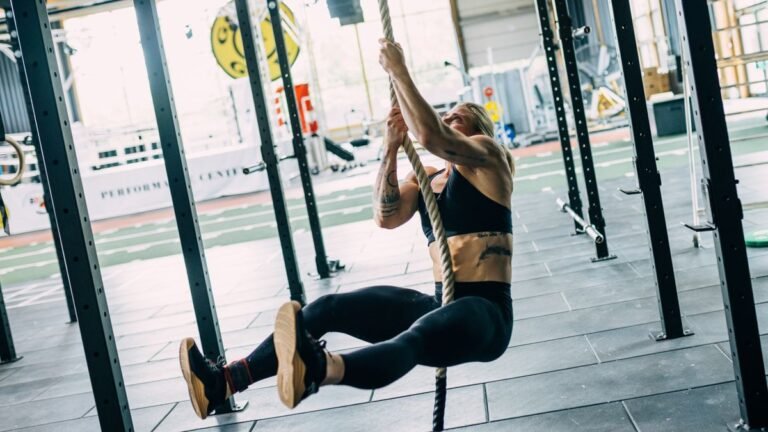
CrossFit may have its detractors, but most agree that the training top CrossFit athletes subject themselves to is among the most demanding fitness regimens in the world. These athletes train for the CrossFit Games, an annual test designed to find the fittest man and woman on earth.
The Games have certain recurring movements, such as burpees, double-unders, pull-ups, snatches and clean and jerks, as well as running and spells on cardio machines.
However, organizers like athletes to be prepared for the “unknown and unknowable”. In the past, that meant peg-board ascents, ocean swims, paddleboarding and free-standing handstand push-ups.
For this reason, professional CrossFit athletes’ training tends to be varied, combining strength work, power development, aerobic capacity building, mobility, coordination and gymnastic skill development.
But just how intense is a CrossFit athlete’s weekly schedule? After the 2023 Berlin semi-final event, I had the chance to sit down with some of Europe’s top CrossFit talent—Reign Total Body Fuel athletes Emma McQuaid, Emma Tall, Moritz Fiebig and Aniol Ekai—so I asked this very question.
How often do CrossFit athletes train?
I tend to spend 90 minutes to two hours at the box each morning. That’s a lot for me, but it’s nothing compared with what CrossFit’s elite commit to.
“To prepare for semi-finals I was training two days a week,” says Aniol Ekai, Europe’s 15th fittest man in 2023.
My eyes widened. Could it be possible to build superhuman fitness by throttling back my training? Unfortunately, Ekai quickly corrected himself.
“Ah, no, two sessions a day, six days a week,” he said. That sounds more like it.
“The morning sessions are two to three hours long, then the afternoon sessions are always less than two hours. So that’s five hours each day, split into two sessions.”
Ekai acknowledges that that’s not the only way to train for Games greatness. Serial Games athlete Emma McQuaid agrees.
“Every athlete is completely different and has different needs,” says McQuaid. “I train five days a week, but I won’t train six. If I train six days a week I feel a little bit more fatigued, so I take one day for swimming and one full rest day a week,” she explains.
“Other athletes are better with more volume. [It can depend on] your training years in this sport, obviously your age, and your lifestyle.
“I wouldn’t say any two athletes follow the same training structure. What might work for one person, might not work for another.”

How do CrossFit athletes periodize their training?
The training of any sportsperson goes through phases of stress and adaptation which will dictate what they do on any given day, and it’s no different for CrossFit athletes.
For the group I spoke to, and many others like them, the off-season is all about working on weaknesses. Then, they ramp up the intensity of their sessions as competitions like the semi-finals (May-June) and CrossFit Games (July-August) approach.
“For me, the off-season would start straight after the CrossFit Games,” says McQuaid. “So, winding it back to last season, there was a big emphasis for me on gaining a little bit more muscle mass and strength—that was the focus.
“Most years, we’ll pick an area that needs attention. In the past it’s been engine and capacity. Last year my sole focus was building strength and mass, so I had to massively reduce my training intensity and volume.
“It was a big change for me personally, but I think every individual has a different focus in the off-season, then start to build [for competitions] from January.”
Games athlete Emma Tall, on the other hand, says her training volume tends to stay fairly consistent throughout the year. “It’s more what’s in there that changes,” she tells me.
Aniol Ekai, meanwhile, says it’s the intensity of his sessions that switches, with his coach ramping up the duration of, and effort required for, his workouts as competition time approaches.
Fiebig, on the other hand, says he’s going to take a leaf out of McQuaid’s book and introduce an off-season after the 2023 CrossFit Games.
“I will learn from Emma because I had no off-season last year,” he says. “I went straight after the Games to another competition and then the next competition, then it was February again and time for the next CrossFit Open. This year I will do an off-season.”
To read more about each shoe, head for our guide to the best CrossFit shoes.
Adam Smith is an accomplished individual who serves as an chief contributor at Healthify Magazine, a leading publication dedicated to promoting health and wellness. With a passion for empowering individuals to live healthier lives, Adam brings a wealth of knowledge and expertise to his role.