





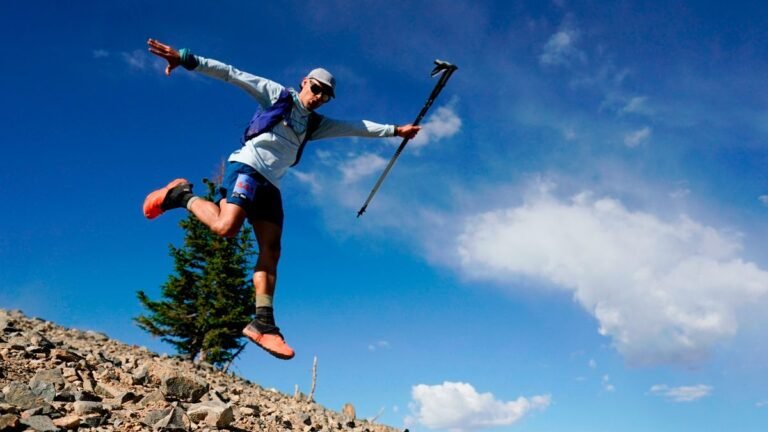
When you first start trail running you don’t need to think about running with poles, unless you take the unlikely first step of heading straight for very long runs in the mountains (which we’d advise against).
Once you are comfortable with trail running and lining up some longer adventures, a good set of running poles is up there with a pair of the best trail-running shoes as one of the most important bits of kit you’ll need.
Running with poles is a skill you’ll need to learn, though, because mastering the technique takes practice. For advice on how to run with poles and what to look for when buying a set, we spoke to Simon James, running coach and founder of trail-running adventure company Run The Wild.
Simon James is the founder of trail-running adventure company Run The Wild. James is a qualified International Mountain Leader, Trail Running Guide and UKA Coach in Running Fitness, and a member of the Explorers Club. James also teaches pole running workshops with Run The Wild.
What are the benefits of running with poles?
They are really good at providing momentum, and keeping your momentum going forward. If you’re using them, even on the flat, you’ll move quicker than if you weren’t. That’s because you’re using your upper-body strength to support your lower body strength.
Where they really come into play is on uphills. You’re using your upper body to push yourself forward, and poles help to keep you a little more upright. That and the rhythmic aspect of using running poles really helps on the uphills, certainly in the mountains, and that’s where they’re mostly used.
On downhills it’s quicker to put the poles away, but if people are on steep or unstable terrain, they can use poles to provide stability. And also they can save your knees.
On ultramarathons or multi-day runs, they’re really good for keeping people going. When running with them you go quicker, but if walking, you also go quicker when using them. If someone’s walking quickly with walking poles, they can get almost up to 6km/h [3.7mph].
Do people use poles on shorter runs as well?
They’re generally not used for shorter runs like a 10K, unless it’s maybe a vertical 3K over 10K. I used them on the Experience Trail Courmayeur at the Ultra Trail du Mont Blanc the year before last, which is a 15K race, and they were brilliant. For sure they helped.
I would say they could help over a 10K distance. But you’ve got to be good at using them. You’ve got to practice with them and use them efficiently. You have to be able to put them away quickly if you’re on for a speedy descent, because if you’re not very good at that, you’re going to find them more of a hindrance than a help.
How do you run with poles?
A key aspect to using poles on anything flat to mildly uphill is that you should be pushing from behind. Running is about moving forward and slightly up, so it’s about pushing yourself forward. Where most people make a mistake is that they put the running poles in front of them to push, and that’s a braking mechanism.
The first technique I get people to practice is how it feels with both poles behind their feet when they’re stationary, and to lean back a little bit and to feel that pressure through their arms. That is what they should feel on shallow uphills and flats, always driving from behind. That’s where the momentum should be coming from.
When things get steeper, the next big tip is double poling—both poles in front planted on the ground in front of you. The first phase of the movement when the poles go in front of you is the upward movement. It brings you up the slope. You step through past the poles still planted in the ground, and the final phase is then pushing you forward, so you still get that forward momentum.
If you look at videos of some of the pros you see it’s almost a full-body movement. They’re getting down low, using their core, using their upper body to push themselves forward and up. You can also vary between alternate poling and double poling.
On uphills, have your hand through the loop on the pole or in the glove if it has one. This means that your forearm can be relaxed—you don’t have to grip the poles hard.
On the downhills the poles go in front of you and you have to take your hand out of the loops, because if you fall you could get your thumb pulled back or break your wrist because you can’t get your hands out of the loop, which is not good. Either have your hands on top of the poles or on the handles.

How much should you practice running with poles before an event?
I would say that during 70% of your hill training you should use poles because you need to develop the muscle tone for using them. You’re less likely to get tendonitis if you practice, and you develop your own form for using the poles as well, so it becomes really efficient.
What should you look for when buying running poles?
They must fold away into a small format; three-segment poles are a must nowadays for trail runners. They must also be lightweight, and strong enough—carbon fiber I would say. Those are the three key things. It’s worth investing in them because if you look after them, they will last a long time.
What else do you need to consider with running poles?
The final thing to consider for poles is having a way of carrying them that you are confident in using, and you can use really quickly. Personally, I use a quiver system. When you’ve got your storage system, I suggest that you turn off the light in your bedroom and try to get the poles in and out in the dark 20 times, so it becomes a reflex.
When you’re running, you get tired and the last thing you want to do is fiddle around with elastic bands and bungees. It’s wasting the energy that you might have saved in using the poles.
You can use a quiver, or a backpack with its own system, and you also get running belt systems as well. It’s really important that you have a system that you can tighten because when you run downhill, they’re going to loosen.
Adam Smith is an accomplished individual who serves as an chief contributor at Healthify Magazine, a leading publication dedicated to promoting health and wellness. With a passion for empowering individuals to live healthier lives, Adam brings a wealth of knowledge and expertise to his role.